
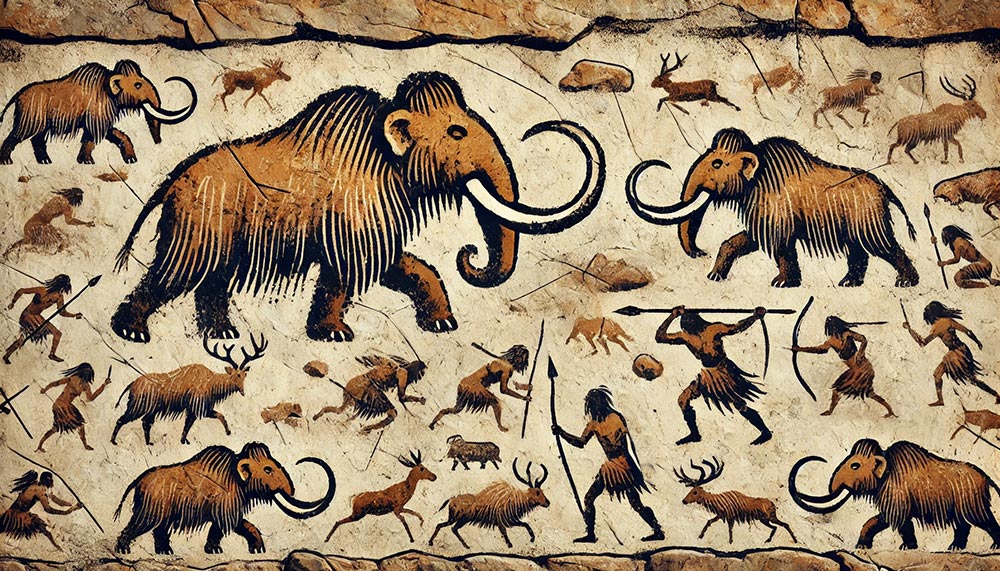
Mankind: More Man, Less Kind
Modern Man arrived late on the scene in the already long-established drama of life on planet Earth. Centre stage was held by fierce carnivores, red in tooth and claw.
For much of its first 300,000 years of existence, this most recent iteration of hominin was a mere bit player, waiting in the wings to clear up the scraps discarded by the terrifying stars of the show, Eking out a precarious existence: supremely adaptable but otherwise still low in the pecking order of megafauna.
Gradually, as language evolved, we developed strategies that gave us the upper hand in the hunt. The opposable thumb of that hand helped fashion and then wield spears with precision.
In Africa, our first home, we only partially trashed the ecosystem, upsetting the equilibrium less than what was to follow elsewhere. Creatures that had coevolved with us were rightly wary of us and our technology. However, despite our still small numbers, we did manage to wipe out the Giant African Buffalo and Short-Horned Giraffe. Fortunately, many others slipped through the net.
There were probably no more than 10,000 to 50,000 humans total when we began to venture forth from Africa 70,000 years ago. At the same time, there were millions of elephants and buffalo and hundreds of thousands of lions and giraffes. Humans constituted less than one-thousandth of one percent of the total biomass of the world’s mammals, ranging from the smallest rodents to the great whales.
The Plunder Down Under
The first wave of Homo sapiens arrived in Australia somewhere between 40,000 and 65,000 years ago and did what humans have always done when they hit virgin territories: slash, burn, then chase and slaughter anything that couldn’t escape. When our ancestors crossed the land bridge that still connected it to Papua New Guinea, the local fauna didn’t know what hit them. With no time to evolve survival techniques to counter already well-honed hunting skills, species fell like ninepins.
By the time European settlers arrived, Australia’s First Nations certainly lived in close harmony with nature, but who knows how long it took to get to that happy state.
How long did reality take to sink in? At what point did it become obvious, in a verbal history with a ‘one, two, many’ counting system, that food stocks were not infinite and were in decline?
We can imagine a scenario where the extended family is still many but the game is perhaps not quite as many as before. The balance would shift slowly, with no way of keeping an accurate tally. An elder might remember that in his or her youth there were many kangaroos and many family members, but it would not have been possible to calculate the supply and demand until food sources became too scarce. A nomadic lifestyle probably masked the decline of larger species until it was too late, at least for the prey species in question.
Of course, a superior counting system doesn’t guarantee better land and wildlife management. ‘First-Fleeters’ ignored the hard-won wisdom of Indigenous Australians and instead tried to impose a system of European land management that was flawed from the start. Large-scale deforestation for agriculture, drastically reduced native habitats. Many invasive species spread aggressively, altering ecosystems and reducing native biodiversity.
A New World Awaits
In the 15,000 or so years after humans followed herds of mammoth and bison across the Bering Land Bridge into North America, about 70% of megafauna was wiped out, including the aforementioned mammoths, along with mastodons, Giant Ground Sloths, Saber-Toothed Cats, camels, tapirs, and a veritable menagerie of never-to-be-seen-again fauna.
Like the mythical frog in boiling water, the people that populated prehistory were probably never aware of the gradual shift in conditions. When the balance between prey and population was destroyed by unsustainable hunting, species were lost, but humans usually found just enough alternatives to survive the lean times.
When Europeans arrived, their ‘superior’ technology polished off large swathes of the remaining wildlife. In 1800, there were 30 to 60 million bison roaming the Great Plains; by the time ‘Bison Bill’ Cody and his mates had finished around 1883, as few as 300 individuals survived.
Massive Shifts in the Biomass
About 6,000 years ago, shortly after the Garden of Eden according to Bible literalists, the actual human population was probably between 20 and 30 million. Humans accounted for less than 1% of total mammalian life, with their domestic animals accounting for another 1 to 2%.
Despite the loss of many large mammals during the initial spread of humans, wild animals still accounted for well over 95% of mammalian biomass on the planet.
When J.C. was in short trousers, or their cultural equivalent, the human population was probably between 170 and 300 million. Humans and their domesticated animals made up about 10 to 20% of the total mammalian life, with the remaining 80-90% still being wild animals.
Sustainability is not hard-wired into us. There is still a “trawl-to-the-last-fish” mentality for example that ignores the catastrophic effects of overfishing.
We stand apart from the natural equilibrium that had slowly evolved, shifted and re-adjusted over millions of years, which had prevented a single species from dominating all others.
Predator numbers have always self-regulated; excess hunters die off or reproduce less, in line with a sustainable population of their prey. We are the exception.
Now, with 8,000,000,000 people, our livestock, and our pets, wild animals represent only a miserable and declining 4% of mammalian biomass!
It seems that too much is never enough, but only when it comes to Homo sapiens.